
CCTV camera, Key card, Network
Factory Security Systems in Chonburi & Rayong: CCTV, Access Control and Alarms
Jul
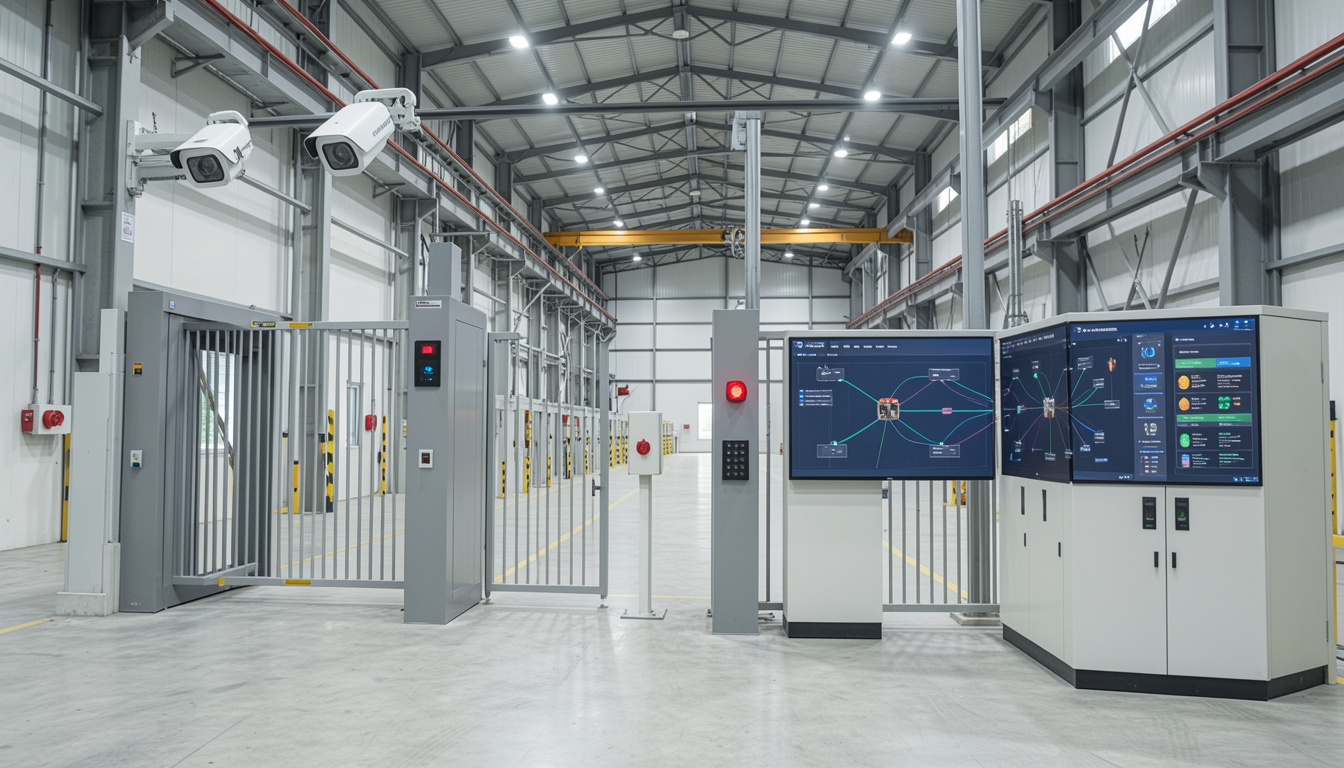
A good factory security system for industrial plants and estates in Chonburi and Rayong is more than cameras in every corner or extra guards at the gate. It means designing everything to work together. That covers keeping outsiders out, controlling access to critical areas, reviewing past events, raising alerts when something is wrong, and managing the data so you can reduce business risk.
Modern factories are complex. There are production areas, warehouses, electrical rooms, server rooms, raw-material stores, loading bays, staff drop-off points, car parks, contractor zones and areas tied to safety standards or customer requirements. When security is built in separate pieces, it becomes hard to see the big picture: cameras in one system, doors in another, staff cards in a third, alarms in a fourth. When an incident happens, time is lost pulling data from several sources.
This guide is for factory owners, plant managers, IT, facility, HR, safety and purchasing teams. It explains what an industrial security system should include, which areas deserve the most attention, how to design a system that works in practice, and what to prepare before installing a new system or upgrading an old one.
Factory Security Installation in Chonburi and Rayong
Systems Connect designs and installs security systems for factories in Chonburi, Rayong, Pattaya, Si Racha, Amata City, Pluak Daeng and nearby areas. We focus on systems that must work reliably every day: factory CCTV, access control, door control, network security, fiber optic links, alarms, and event logs you can review later.
This service suits factories that want to assess risk points, upgrade an existing system, add cameras or access points, or design for future expansion of buildings, production lines or warehouses.
Why Security Matters for Industrial Plants
A factory brings together assets, machinery, raw materials, finished goods, production data and many people. The risk is not only theft. It also includes people entering the wrong areas, goods leaving without authorisation, accidents in hazardous zones, breaches of safety standards, damage to machinery and business-continuity problems.
A single small incident can have wide effects. A missing lot may force a full warehouse check. A worker or contractor may enter a restricted area with no clear evidence. An accident may happen in a blind spot that no camera covers. Without verifiable data, problems take longer to solve, and confidence can suffer among customers, partners and auditors.
A good security system should answer key questions. Who entered which area, at what time, and with which credential? Is there video to confirm it? Where exactly did the event happen, who was alerted, and how many days back can you check? When your system can answer these, the factory is not just “safer”. It manages risk better too.
What an Industrial Security System Includes
Treat factory security as one integrated system, not a series of devices bought to fix the problem of the day. Each part should share data with and support the others. The most common components are:
1. CCTV for Factories
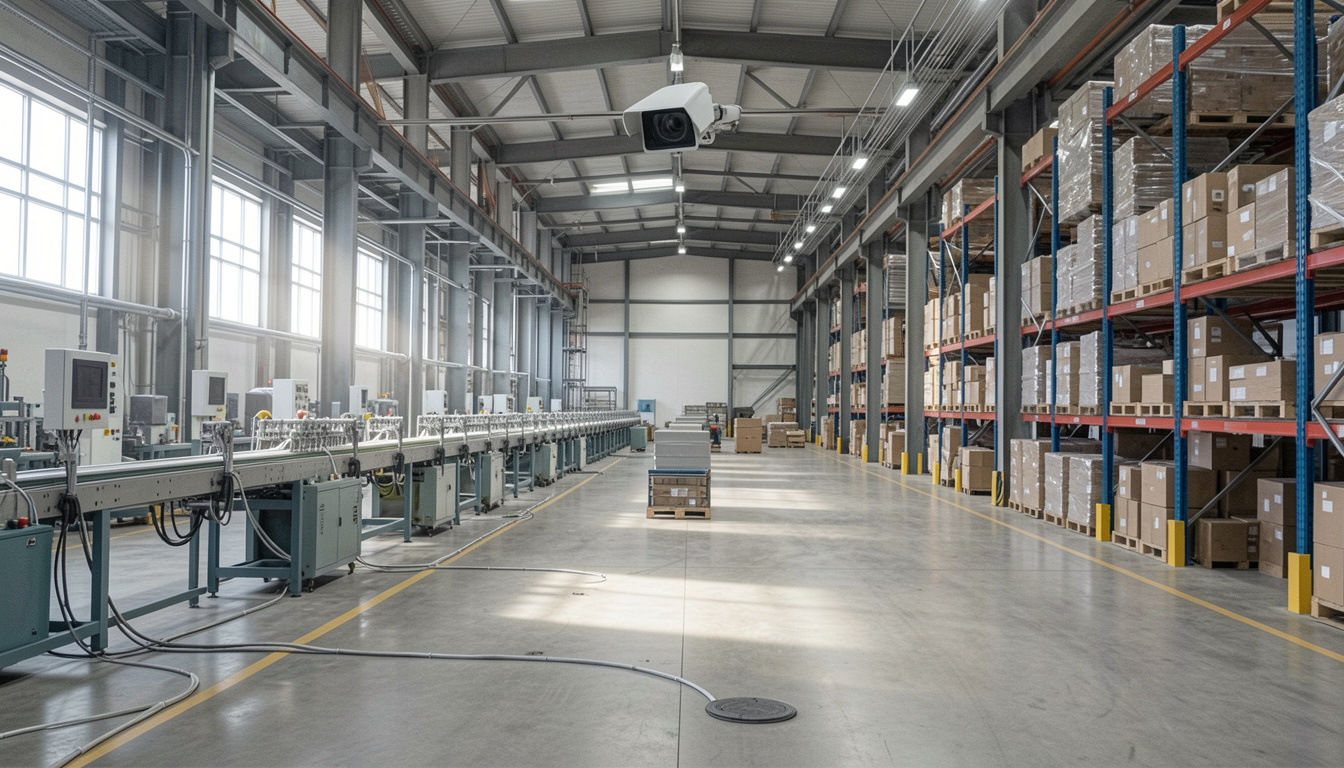
CCTV is the core of incident review and monitoring of critical areas. Choose cameras to suit each location:
- bullet cameras outdoors;
- dome cameras indoors;
- PTZ cameras for wide areas;
- LPR cameras to read licence plates;
- cameras with WDR or low-light performance where there is backlight or little light.
What matters is not the highest camera count but placing cameras where they see what matters. Typical places are:
- gates and main walkways;
- loading points and the raw-material and finished-goods stores;
- expensive machinery, electrical rooms and server rooms;
- weighbridges and spots with a history of repeat incidents.
Consider viewing angle, focal distance, lighting, pole height, blind spots and how long recordings must be kept.
2. Access Control
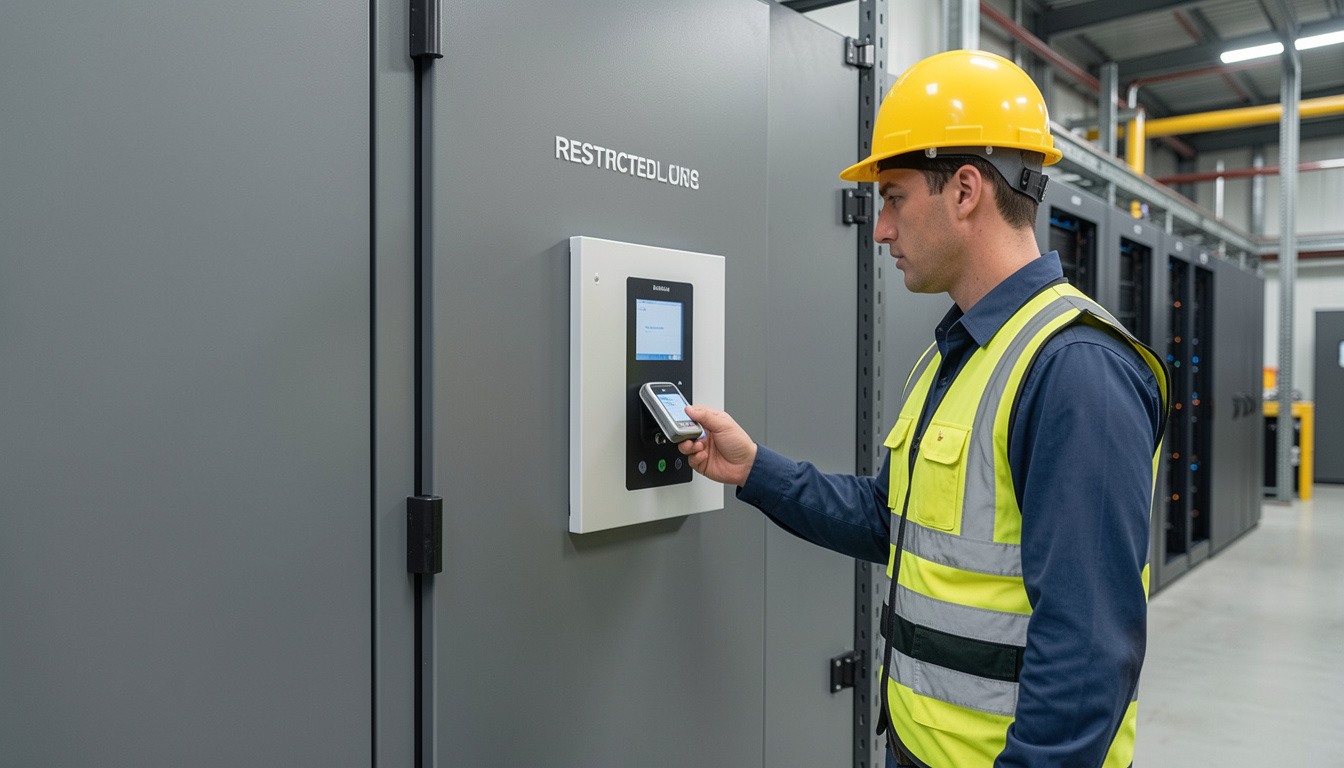
An access control system defines who may enter which area and when. Depending on the security level needed, factories can use proximity cards, MIFARE cards, PINs, fingerprints, face recognition, QR codes or mobile credentials.
Areas that typically need controlled access include:
- server rooms, electrical control rooms, labs and control rooms;
- document rooms and spare-parts stores;
- warehouses and specific production zones;
- main building entrances.
The big benefit is an auditable entry log. Linked with CCTV, it confirms events far more clearly.
3. Time Attendance and Workforce Management
Some factories keep time attendance separate from security, but in practice the two are closely linked. Together they show whether staff are really on site, when they started their shift, when they left, and whether there are unusual entry patterns.
Designed well, time attendance can work with access control to grant rights by shift, department, position or special conditions. Contractors can be allowed in only during approved hours, and some staff groups only into the areas related to their work.
4. Visitor Management for Guests and Contractors
Factories receive many kinds of visitors: customers, suppliers, drivers, contractors, technicians, auditors and members of the public. A paper logbook is often not enough. It is hard to search, handwriting can be unreadable, and it cannot be linked to access rights.
A good visitor management system records:
- who the visitor is, their purpose and the host responsible for them;
- entry and exit times;
- the exchange card or QR code and the areas they may enter;
- photos or documents where needed.
After an incident, you can see straight away who was on site at that time.
5. Intrusion Alarms and Alerts
Some areas should trigger an alert when something unusual happens. Examples are a door opened out of hours, forced entry, movement in a restricted zone, or unauthorised access. Alarms can connect door sensors, motion sensors, beam sensors, sirens and strobe lights, with notifications sent via LINE, email or a control centre.
On large sites, alerts that clearly identify the location are very important. Security or facility staff can respond quickly instead of guessing where the problem is.
6. Network and Fiber Optic Infrastructure
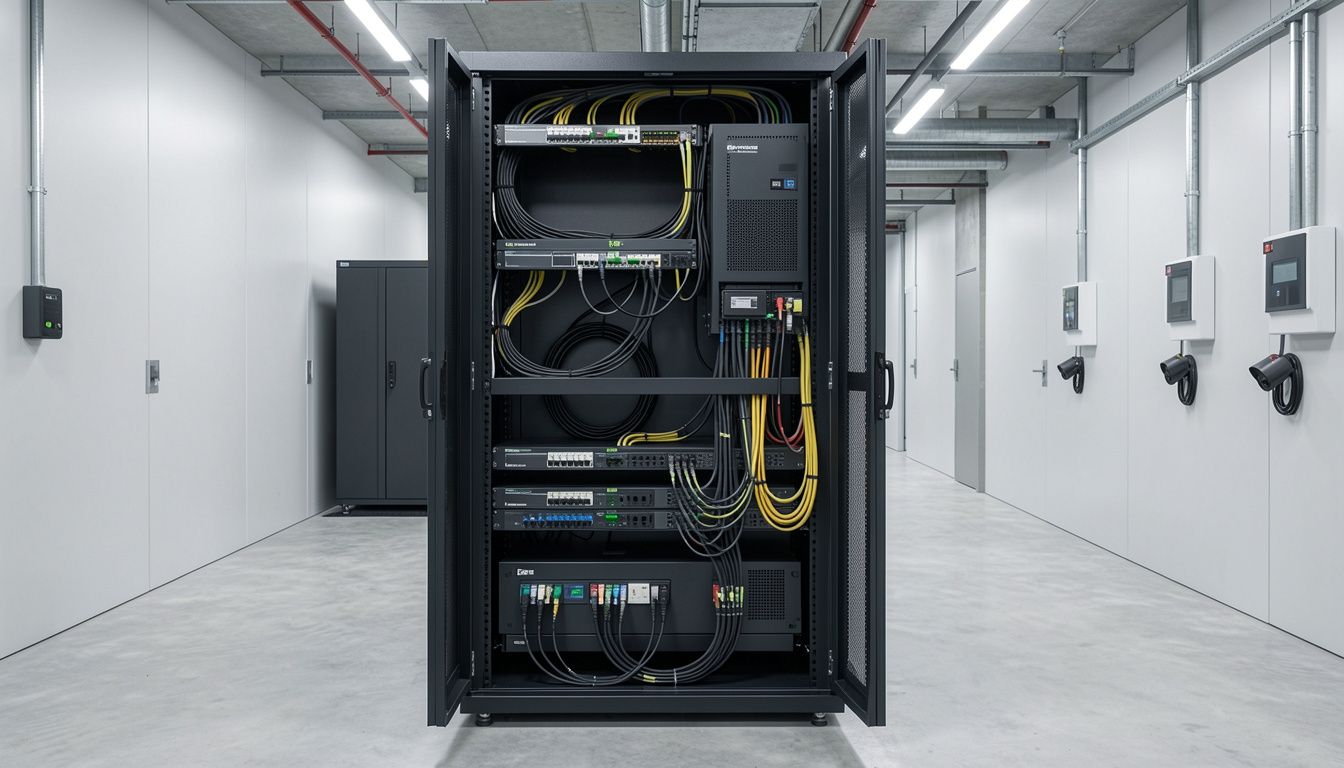
A stable security system depends on a good network. This is especially true for factories with many cameras, several buildings, long cable runs or large outdoor areas. If the network is not ready, video may stutter, access data may not update, and alarms may not arrive in real time.
In industrial plants, the network, VLANs, PoE switches, fiber optic links, racks, UPS and backup power should be designed together with the security system from the start. Separating the camera and security network from the office network improves stability and reduces cybersecurity risk.
Key Factory Areas That Need Special Attention
Not every area needs the same level of security. Zoning the site by risk lets you design the right system and keep the budget under control.
Main Gates
Cameras here should clearly capture vehicles, people, licence plates and entry behaviour. If there is a guard house, place monitoring screens and recording tools so they are easy to use. For factories with heavy truck traffic, consider licence-plate cameras together with a visitor or truck-booking system.
Loading Bays and Warehouses
Loading areas are prone to mix-ups, losses and disputes over quantities. Cameras should cover the truck, the loading area, the warehouse door and the route goods travel. For high-value goods, add access control or a log of warehouse door openings.
Server Rooms and Control Rooms
Server rooms, control rooms, electrical rooms and communications rooms need tighter control than general areas, because problems there affect the whole factory. Cameras at the door and at suitable points inside, plus detailed entry logs, reduce the risk of unauthorised access.
Production Areas and Critical Machinery
Some production zones have limits on camera angles, privacy, worker safety or customer requirements. Cameras must not disrupt work but must still capture usable evidence. Typical points are the start and end of production lines, quality-control points, holding areas and places where accidents have happened before.
Perimeter Fences and Blind Spots
Large sites often have blind spots: fence lines, the backs of buildings, car parks, material storage yards and little-used walkways. Assess the lighting, environment and cable distance before choosing cameras or sensors. Over long distances, fiber optic may be a better choice than standard LAN cable.
Design Principles for a Factory Security System That Works
The best system is not the most expensive one. It is the one that matches your risks, is easy to use, can be audited and can be maintained for years. The key principles are:
Start With a Risk Assessment, Not a Camera Count
Before deciding how many cameras or doors you need, assess the risk of each area. Where are the high-value assets? Where is sensitive data? Where do outsiders come and go? Where do incidents happen most? Where would a problem stop production? A risk assessment puts your investment in the right place, so you do not install a lot of equipment and still miss the critical points.
Design for Linked Evidence
When something happens, you should be able to link the data. Who passed which door at that moment? Which camera saw it? Which sensor raised the alarm, and who was responsible for checking it? Linking CCTV, access control, visitor management and alarms cuts investigation time dramatically.
Assign Rights by Role and Area
Not every employee should be able to enter every area. Grant rights by department, position, shift and task:
- production staff only into their own production area;
- warehouse staff only into the warehouses they work in;
- contractors only during approved hours;
- managers and engineers only where they need to be.
Plan for Video Retention
Many factories install high-resolution cameras without calculating storage, and end up unable to keep footage long enough. Calculate based on camera count, resolution, frame rate, compression, recording purpose and the number of days you must keep. Some areas may need longer retention than others, such as loading points, cash points and high-value storage.
Provide Backup Power and an After-Installation Plan
Security systems must keep running during power cuts or local faults. Put critical equipment on UPS: NVRs, servers, core switches, access control controllers and main network devices. Also plan regular health checks: camera images, hard drives, door logs, firmware and alarm tests.
Common Mistakes When Installing Factory Security
Many factories have all the equipment yet still do not get full value from it, because of mistakes during design or after installation.
Lots of Cameras, Still Blind Spots
More cameras does not mean better coverage. If views overlap too much but miss key details, the system still fails. Examples are licence plates, faces at entrances and the routes goods travel. Site surveys and real image tests are essential.
Sharing One Network With the Office
Many IP cameras use a lot of bandwidth. If they share the office network without VLANs or properly designed switches, the internet and internal systems can slow down, and data security risk increases.
No Clear System Owner
After installation, decide who manages user rights, who reviews logs, who receives alarms, who checks camera health and who calls the service team when there is a problem. Without a clear owner, the system often degrades unnoticed until an incident happens.
No Plan for Expansion
Factories add buildings, production lines and warehouses, or change layouts. If the original system did not allow spare ports, bandwidth, storage, rack space or licences, expanding later can be harder and more expensive than it should be.
Factory Security and Cybersecurity
As security moves from analogue to IP, IP cameras, NVRs, access controllers and servers become part of your IT system. Easy passwords, ports opened to the internet without need, or outdated firmware can create cybersecurity risks.
The basics are:
- change default passwords;
- separate the security network from the general user network;
- limit admin rights;
- use a VPN when you must view video remotely;
- log system logins;
- remove devices that are no longer used.
That is why IT or network specialists should be involved in security design from the start.
Example Designs by Factory Type
Each type of factory has different risks, so the design should follow the production process and the site.
Industrial Parts Manufacturing
These plants often have expensive machinery, specialised raw materials and large storage areas. Focus on cameras on production lines, raw-material stores, finished-goods stores and loading points, plus access control for control rooms and tool rooms.
Food and Beverage Plants
Beyond asset protection, these plants must meet hygiene standards, control access to production areas and support traceability. Design visitor management and access control to manage outsiders well, and place cameras where they do not conflict with cleanliness requirements.
Warehouses and Distribution Centres
The key points are tracking goods movement, loading doors, storage areas, yards and truck routes. If you run night shifts, choose low-light cameras or add lighting at important points.
Multi-Building or Large Sites
Design a clear network backbone. This may mean fiber optic between buildings, racks per zone and device-status monitoring, so the team knows immediately when a camera or switch has a problem.
What to Prepare Before Requesting a Security Assessment
Before the project starts, gather basic information so the survey and design are accurate:
- site plans, the number of gates and the number of buildings;
- past incident points;
- headcount and shift patterns;
- visitor types and daily vehicle traffic;
- areas that need access control;
- required video retention;
- future expansion plans.
With this information, the designer can estimate cameras, mounting points, equipment types, network structure, storage, UPS and budget much more realistically. It also reduces the risk of repeated redesigns or buying equipment that does not fit the site.
How to Choose a Factory Security Installer
Do not judge installers on equipment price alone. Factory systems need real site understanding. A good installer can:
- survey the site and design camera views;
- plan the network and choose equipment that suits the environment;
- run cables neatly;
- provide handover documents and advise on maintenance after installation.
Questions to ask before deciding:
- Will you survey the site before quoting?
- Are device models clearly specified, and how is storage calculated?
- Is there a layout of mounting points?
- How far can the system be expanded, and how is the network separated?
- Are basic security settings configured for us?
- What after-sales service do you provide?
Related Services
- CCTV cameras for factories
- Network and fiber optic systems for factories
- IoT devices for factories in Chonburi and Rayong
- Network systems
- Request a factory security assessment
FAQ: Factory Security Systems
Where should an industrial security project start?
Start with a risk assessment and zoning, not an immediate camera count, because each area carries different risk. Once you know which areas matter most, design the CCTV, access control, alarms and network around real needs.
What type of CCTV camera should a factory use?
It depends on the area. Outdoors, use weather-resistant cameras with water and dust protection. In low-light areas, choose low-light or IR cameras. At entrances, prioritise clear faces and licence plates. Wide areas may combine PTZ and wide-angle cameras.
Does every factory need access control?
If your factory has critical areas such as server rooms, electrical rooms, warehouses, document rooms or specialised production zones, access control is worth considering. It restricts entry and keeps entry logs far better than ordinary keys.
How many days of video should we keep?
It depends on factory policy, the type of risk and customer or standard requirements. Many factories want 15, 30, 60 or 90 days. Calculate it from your actual camera count, resolution and recording mode rather than guessing.
Should the security system be connected to IT?
Yes, to a suitable degree, especially IP cameras, access control and servers that share the network. But separate them with VLANs or network segments for stability and security. Do not leave all devices on the same network as general users without control.
If we already have a system, do we need to replace everything?
Not necessarily. Survey the existing system first to see what can stay, what should be replaced and what should be added. Parts can often be reused. You might keep some cameras, add a new NVR, improve the network, or add access control to high-risk areas first.
What should factories in Chonburi, Rayong and industrial estates focus on?
Designs that handle large sites, several buildings, heavy goods traffic and future expansion. Factories around Amata City, Pluak Daeng, Rayong, Chonburi and Si Racha often need a stable network, camera coverage of loading points and access control for specialised areas.
Summary: Good Factory Security Is More Than Equipment
An effective industrial security system starts with understanding the risks of each area, not with buying as much equipment as possible. It should let the factory see important events, control access, review the past, link evidence across systems and stay maintainable for the long term.
If you plan to upgrade an existing system, add CCTV, install access control, separate the security network or design a new system for several buildings, start with a site survey and an overall plan. That way your investment does more than get “installed”: it reduces risk and gives you real confidence in running the factory.
Planning factory security in Pattaya, Chonburi or Rayong? Call 033-265-438, 096-246-2324, LINE @Nicesystem (include the @), or contact us online. Service area: Pattaya, Bang Lamung, Sattahip, Si Racha, Chonburi city, Amata City, Pluak Daeng, Rayong and nearby areas.
Pingback: Ubiquiti vs Grandstream vs TP-Link: Business WiFi Compared